LISTEN · കേൾക്കാം
Listen to this article
English audio for this article is not available yet.
Rev. Fr. Johnson Punchakonam | A Biblical, Historical, and Patristic Study
The question: I was baptized before I was old enough to understand. Would it not be better to receive baptism when I can personally believe and make my own decision?
📖 1. What Is Baptism?
In the Malankara Orthodox Syrian Church, baptism is not merely a declaration of personal belief. It is a holy sacrament through which, by God's grace, we participate in the death and resurrection of Jesus Christ (Romans 6:3–4). John 3:5 speaks of being born of water and the Spirit; Titus 3:5 describes the washing of regeneration and renewal by the Holy Spirit. These passages illuminate the sacramental meaning of baptism, although neither directly commands the baptism of infants.
📜 2. Evidence from the New Testament
Acts 2:38–39: Alongside Peter's call to repent and be baptized, he declares that God's promise is for his hearers and their children. This verse does not, however, directly describe the baptism of newborn infants.
Colossians 2:11–12 and Genesis 17:12: Supporters of infant baptism point to the covenantal relationship between circumcision and baptism. Paul does not say that these two rites are identical.
Acts 16:15, 16:33, and 1 Corinthians 1:16: These passages describe the baptism of households. They do not establish whether infants were present in those households.
Mark 10:13–16: Jesus welcomes and blesses little children. Baptism does not take place in this episode.
⚖️ 3. The Argument for Believer's Baptism
Matthew 28:19–20, Acts 2:38, and Acts 8:36–38 connect baptism with teaching, faith, and repentance. For this reason, some Christian communities administer baptism only after an individual personally professes faith. The Orthodox Church likewise requires instruction and a confession of faith from adult converts. For infants, the sacrament is administered within the faith of the Church and their parents, with the expectation that they will grow into a personal, conscious commitment to Christ.
🏛️ 4. Documented Evidence from the Early Church
Irenaeus (Second Century)
In Against Heresies II.22.4, Irenaeus speaks of Christ saving people of every age, including infants. Scholars differ over whether his language about being “born again” specifically refers to baptism here. Read the primary text.
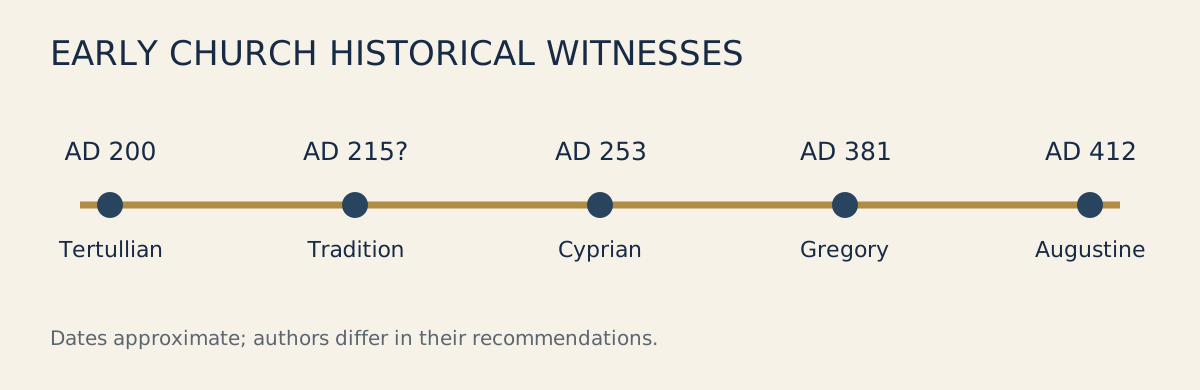
Tertullian (Approximately AD 200)
In On Baptism, chapter 18, Tertullian advises delaying the baptism of children. His objection is itself direct evidence that the practice was known in his time. He should not be misrepresented as an advocate of immediate infant baptism. Read the primary text.
The Apostolic Tradition, Chapter 21
This early liturgical text describes parents or relatives answering on behalf of children who cannot answer for themselves. The authorship, textual history, and precise dating of the work remain subjects of scholarly debate.
Origen (Third Century)
In Homilies on Leviticus 8.3 and Commentary on Romans 5.9, passages attributed to Origen associate infant baptism with apostolic tradition. This is a historical claim made within the tradition, not independent first-century documentation proving that every apostle baptized infants.
Cyprian of Carthage (Approximately AD 253)
In his letter to Fidus, Cyprian reports the judgment of a council of 66 bishops that an infant's baptism need not be postponed until the eighth day after birth. This is among the strongest direct documentary witnesses to the practice in the third century. Read the primary text.
Gregory of Nazianzus (Fourth Century)
In Oration 40.28, Gregory recommends prompt baptism for infants in danger, while suggesting that in other circumstances baptism may be delayed somewhat. His counsel illustrates diversity in pastoral practice without rejecting infant baptism itself. Read the primary text.
Augustine (Early Fifth Century)
In On Merit and the Forgiveness of Sins, and the Baptism of Infants, Augustine discusses infant baptism as an established ecclesial practice. His Western interpretation of original sin must be distinguished from Eastern Orthodox accounts of ancestral sin. Read the primary text.
🕊️ 5. The Malankara Orthodox Understanding
The Church does not teach that a newborn infant has consciously committed personal sins. Rather, baptism brings a person living within the human condition affected by Adam's fall into new life in Christ. Parents and godparents undertake the responsibility of nurturing the child in faith. Baptism, anointing with Holy Mooron (Chrismation), and participation in the Holy Eucharist belong together within initiation into Christian life.
❓ 6. Does Personal Choice Still Matter?
Absolutely. As a child grows, the grace received in infancy must be embraced personally through faith, prayer, repentance, participation in the Holy Qurbana, and works of love. God's gracious initiative and a person's free response are not opposites (Ephesians 2:8–10).
✝️ 7. Is a Second Baptism Necessary?
Ephesians 4:5 and the Nicene Creed confess “one baptism.” According to Orthodox teaching, someone validly baptized according to the Church's sacramental order does not need to be baptized again upon reaching an age of understanding. Instead, that person is called to grow in the faith into which he or she was baptized.
🔎 8. Historical Honesty and the Limits of the Evidence
The New Testament contains no unambiguous account of a newborn infant being baptized. Nevertheless, historical sources show that infant baptism was known by approximately AD 200 and received explicit support from church leaders in the third century. The claim that all apostles baptized infants in every Christian community cannot be established beyond dispute from surviving documents.
💡 Conclusion
“The most important question is not simply whether I was baptized before I could understand, but whether, now that I have understanding and discernment, I am living the faith of my baptism.”
Research note: Early Christian writings are historical witnesses, not direct biblical commands. For the exact liturgical wording used in the Malankara Orthodox Syrian Church, consult its authorized Syriac or Malayalam baptismal service book.
FROM THE ORTHODOX TV ARCHIVE
Love God & Love Life.
PASS IT ON
Share this reflection.