In the name of the Father, and of the Son, and of the Holy Spirit. One God. Amen.
Brothers and sisters, let me begin with a question. What is the first Scripture you ever learned by heart? For many of us, it was this one. We learned it as children, we heard it at the bedside of a grandparent, and we heard it at a funeral. It is only six verses long, and yet the Church has prayed it for thousands of years: "The Lord is my shepherd; I shall not want."
Today I want us to slow down and hear it as the Church hears it. We will walk through it in four steps: the Shepherd who provides, the Shepherd who stays with us in the valley, the Shepherd who sets a table, and the House where he leads us at last.
(Pause.)
First: A Shepherd Who Provides (verses 1–3)
David wrote this. Before he was a king, he was a shepherd boy, and he knew what sheep are like. Sheep are not clever. They wander. They cannot find water without help. They will not even lie down to rest unless they feel safe. David knew all this, and then he looked at his own life and said, in effect: "That is me, and the Lord is my shepherd."
Notice two small words. The Lord is my shepherd. Not "a" shepherd, not "the" distant ruler of the universe. The King of Heaven has made himself personally responsible for me. And then the promise: "I shall not want." That does not mean I will get everything I wish for. It means that nothing I truly need will be missing.
Then the psalm gives us pictures of rest. "He maketh me to lie down in green pastures; he leadeth me beside the still waters." A sheep only lies down when it is not afraid. So the shepherd must make that peace. Brothers and sisters, how many of us are tired right now, not only in body, but in soul? Our Lord says, "Come to me, all who labour and are heavy laden, and I will give you rest." The pasture is where he feeds us. The Fathers understood the pasture as the Holy Scriptures and the life of the Church, and the still waters as the waters of Baptism and the grace of the Holy Spirit.
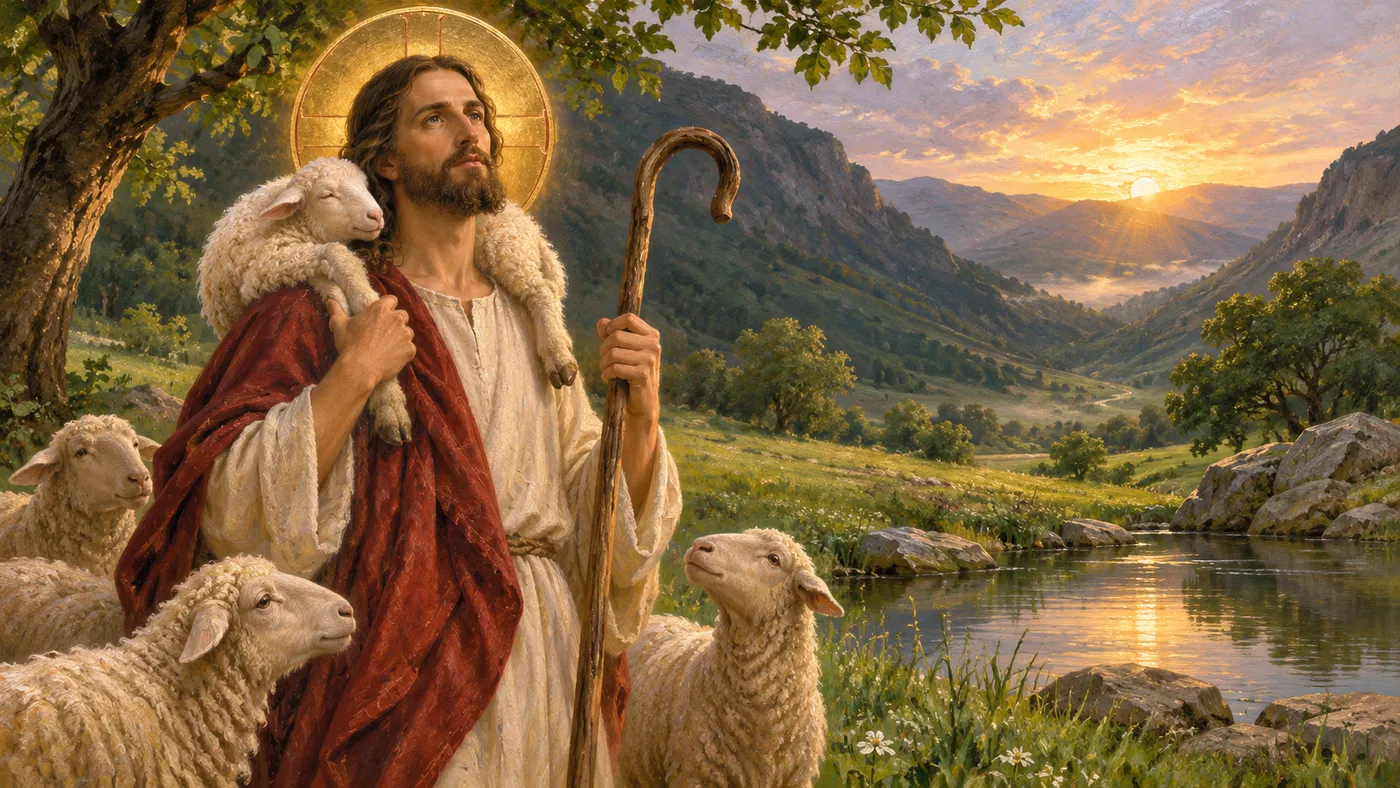
Next: "He restoreth my soul." This is the language of repentance. The Greek word we know is metanoia, a turning back. Some of us feel we have strayed too far. But the Shepherd in Jesus' parable does not wait for the lost sheep to find its way home. He goes out and finds it and carries it on his shoulders, rejoicing. That is why the Church gives us Great Lent, and Confession, and daily prayer: not to shame us, but because the Shepherd keeps bringing us back.
Second: A Shepherd Who Walks With Us (verse 4)
Now listen to what happens in the middle of the psalm. For three verses David has been talking about God: "He makes me lie down. He leads me. He restores me." Then comes the dark valley, and suddenly the grammar changes. David stops saying "he" and begins to say "you": "Yea, though I walk through the valley of the shadow of death, I will fear no evil, for you are with me."
I find that deeply true to life. When things are easy, we can talk about God. When things are frightening, we talk to him. Fear can become the doorway into real prayer.
And look at what David does not say. He does not say that there will be no valley. He does not say "if" I walk through it. He says "though." Every one of us will walk through some valley: the hospital corridor, the empty chair at the table, the diagnosis, the night we cannot sleep. The psalm does not deny the valley. It says that we walk through it, which means it has an end, and that we do not walk alone.
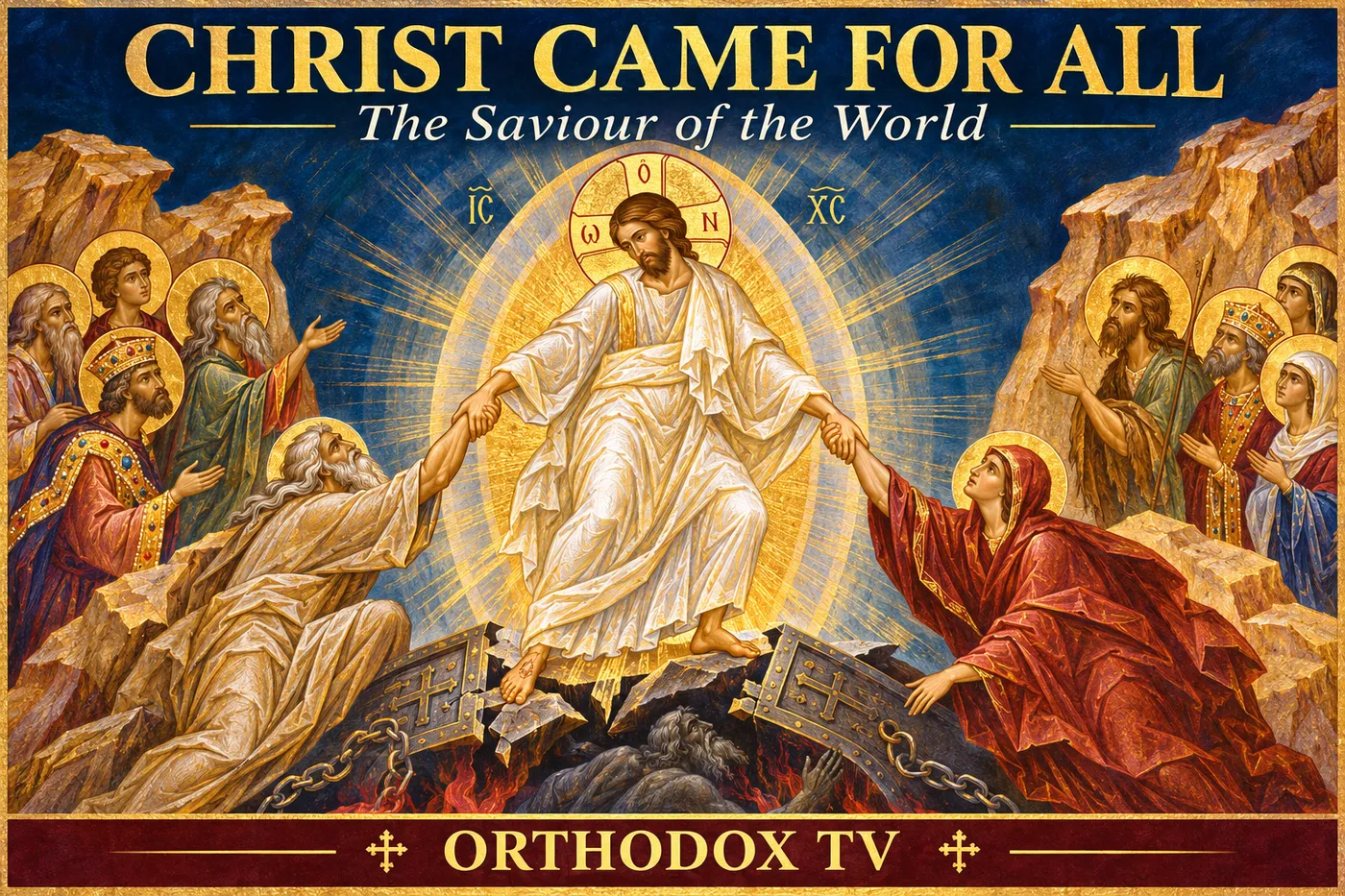
As Orthodox Christians, we read this verse in the light of Pascha. Our Shepherd has already walked this valley ahead of us. Christ went down into death, and he trampled down death by death. Every Pascha we sing it: Christ is risen from the dead, and upon those in the tombs he has bestowed life. So when we pray this psalm at a funeral, in our homes and in our churches, we are not whistling in the dark. We are confessing that the Shepherd has gone before us, and that the rod and the staff, which the Fathers saw as signs of the Cross, are in his hand.
So here is something to take home. When you are afraid, say these words slowly, and join them to the Jesus Prayer: "Lord Jesus Christ, Son of God, have mercy on me."
Third: A Shepherd Who Sets a Table (verse 5)
Then the picture changes again. The shepherd becomes a host. "Thou preparest a table before me in the presence of mine enemies; thou anointest my head with oil; my cup runneth over."
In the ancient world, to eat at someone's table was to be under their protection. To be fed in front of your enemies, calmly, while they could do nothing, was a sign that the host's care was stronger than any threat.
The early Church heard in this verse the Holy Mysteries. Saint Cyril of Jerusalem, speaking to the newly baptized, took the table and the cup of this psalm and applied them directly to the Holy Eucharist. And the oil? We, in the Malankara Church, know that oil. We were sealed with the Holy Mooron when we were baptized, and the Church anoints the sick with oil. And the overflowing cup is the cup of the Holy Qurbana, in which we receive the Body and Blood of Christ for the forgiveness of sins and life eternal.
Brothers and sisters, when you walk up to receive the Holy Mysteries, you are not attending an event. You are sitting at the Shepherd's table, which he prepared for you, and he is the one who serves. And he does it in the presence of our enemies: our worries, our failures, our fears, and the powers of darkness. They are all watching, and they cannot touch what he gives.
Fourth: A House Where We Dwell Forever (verse 6)
The psalm ends with one of the most beautiful sentences in the Bible: "Surely goodness and mercy shall follow me all the days of my life, and I will dwell in the house of the Lord for ever."
The word "follow" is gentle in English. In Hebrew it is stronger: goodness and mercy pursue me. They chase me. Think about that. We usually imagine that we are the ones chasing God, trying to be good enough, trying to catch up. But the psalm says God's mercy runs after us, even when we are the ones running away. That is what we see in the Prodigal Son, whose father runs down the road to meet him.
And where does the chase end? In the house of the Lord. For us, this means two things. It is the Church, where heaven and earth meet in our worship, where we stand with the angels and the saints. And it is the Kingdom of Heaven, the house with many rooms that Christ promised to prepare for us. We do not earn our way in. We are brought in, by a Shepherd who laid down his life for the sheep.
Let me conclude: Christ the Good Shepherd
Let me draw it together. This psalm is not only about David, and it is not only about us. The Church hears Christ in every line. He says, "I am the Good Shepherd." He is the one who leads us to the still waters of Baptism, who restores us in repentance, who goes before us through death, who feeds us at his table, and who brings us home.
So here is what I ask of you this week. First, pray this psalm each morning, one slow verse at a time. Second, when a valley comes, say verse four out loud. Third, when you come to the Holy Qurbana, remember whose table it is. And fourth, look around you. Who in our parish is a lost sheep: the lonely, the grieving, the sick, the one who has not been in church for a while? Be a small sign of the Shepherd's care to them.
Let us pray.
O Good Shepherd, you know each of us by name. When we are weary, give us rest. When we stray, bring us back. When we walk through dark valleys, be near us. Feed us at your holy table, anoint us with your Spirit, and at the end of our days, bring us into your Father's house. Glory to the Father, and to the Son, and to the Holy Spirit, now and always and forever and ever. Amen.
FROM THE ORTHODOX TV ARCHIVE
Love God & Love Life.
PASS IT ON
Share this reflection.